
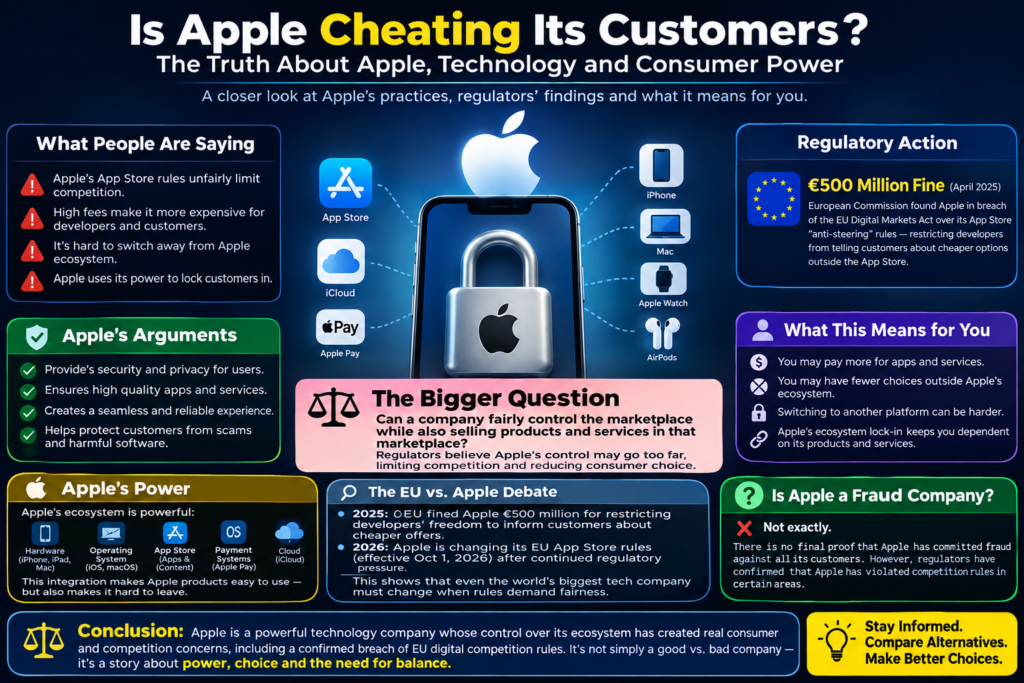
introduction
Apple is one of the most successful technology companies in the world. Its iPhone, iPad, Mac, Apple Watch, AirPods, App Store, and other services are used by hundreds of millions of people.
The company is famous for designing products that are easy to use, tightly integrated, and marketed as premium technology. Millions of customers are willing to pay higher prices because they believe Apple provides better quality, security, privacy, and customer experience.
But there is another side to the story.
Critics, developers, competitors, regulators, and some consumers have questioned whether Apple uses its enormous control over its technology ecosystem to make customers and businesses more dependent on Apple.
Does that amount to cheating?
Does Apple commit fraud?
Or is Apple simply operating a powerful business model that regulators increasingly believe needs stronger limits?
The answer is complicated. There is a major difference between aggressive business practices, anti-competitive behavior, and fraud. Not every practice that feels unfair is legally fraud.
What Does “Cheating Customers” Actually Mean?
When people say that a company is “cheating” customers, they can mean many different things.
They might mean:
- charging excessively high prices;
- making it difficult to repair a product;
- restricting access to alternative services;
- locking customers into an ecosystem;
- limiting competition;
- charging developers high fees;
- making certain features available only through Apple;
- or using technology in a way that gives Apple an advantage over competitors.
These practices can be controversial without automatically being fraudulent.
Fraud generally involves deliberately deceiving someone for financial or personal gain. Therefore, it would be irresponsible to simply say, “Apple is a fraud company” without evidence establishing that Apple committed fraud.
However, there are documented regulatory findings showing that Apple has violated competition rules in certain circumstances.
Apple's Control Over the App Store
One of the biggest controversies involves the App Store.
On an iPhone, Apple controls the operating system and the official App Store. Developers who want to reach iPhone users have historically had to operate within Apple’s rules.
Apple also takes commissions from certain transactions.
The argument from Apple is that this system provides security, privacy, quality control, and a convenient experience for users.
Critics argue that Apple is simultaneously acting as the owner of the platform and a competitor within that platform.
This creates an important question:
Can a company fairly control the marketplace while also selling products and services in that marketplace?
That question has attracted significant attention from regulators.
The €500 Million EU Fine
This is one of the strongest documented examples that should be included in any serious discussion of Apple’s business practices.
On April 23, 2025, the European Commission found that Apple breached the Digital Markets Act’s anti-steering obligation.
The issue concerned developers’ ability to tell customers about alternative purchasing options outside Apple’s App Store.
According to the European Commission, Apple’s restrictions prevented developers from fully benefiting from alternative distribution channels and prevented consumers from fully benefiting from alternative and potentially cheaper offers.
The Commission fined Apple €500 million. (Digital Markets Act (DMA))
This does not mean that every Apple product is fraudulent or that every Apple customer has been defrauded.
It does, however, demonstrate that a major regulator concluded that Apple’s App Store practices violated a specific European digital competition law.
Is Apple Trying to Lock Customers Into Its Ecosystem?
Another criticism is Apple’s ecosystem.
Consider someone who owns:
- an iPhone;
- an Apple Watch;
- AirPods;
- a MacBook;
- iCloud storage;
- Apple TV;
- and numerous App Store purchases.
These products work extremely well together.
That is one of Apple’s greatest strengths.
But the same integration can make leaving the ecosystem difficult.
A customer may have purchased apps, subscriptions, accessories, cloud storage, and other services that work particularly well with Apple products.
This creates what economists and technology analysts often call ecosystem lock-in.
Lock-in is not necessarily illegal or unethical. Almost every major technology company tries to build an ecosystem that encourages customers to remain with its products.
The concern arises when technological restrictions are used not simply to improve the product but to make competition unnecessarily difficult.
Apple's Argument: Security and Privacy
It is important to consider Apple’s side.
Apple argues that many of its restrictions exist for legitimate reasons.
For example, controlling app distribution can help Apple:
- review applications;
- reduce malicious software;
- protect payment information;
- prevent certain scams;
- protect children;
- maintain privacy controls;
- and provide a consistent user experience.
These are legitimate concerns.
Allowing completely unrestricted software installation can create additional security risks.
Therefore, critics cannot simply say:
“Apple controls everything, so Apple must be cheating.”
The real question is whether a particular restriction is necessary and proportionate for security—or whether it also protects Apple’s commercial interests at the expense of competition.
That distinction is extremely important.
Apple and Alternative App Stores
The European Union has introduced the Digital Markets Act partly because regulators believe extremely powerful digital platforms need additional obligations.
Apple has been designated as a “gatekeeper” for services including iOS, Safari, and the App Store. (Digital Markets Act (DMA))
The EU has therefore required Apple to provide users and developers with more choices.
Apple has resisted some of these changes and has argued that alternative distribution and payment systems can create security and privacy problems.
The European Commission, meanwhile, has continued to scrutinize Apple’s conditions for alternative app distribution. (Digital Strategy)
This debate illustrates the larger conflict:
Apple says control protects users. Regulators say too much control can restrict competition.
Both arguments deserve examination.
What About Apple's Technology?
Apple’s technology itself is not necessarily the problem.
In many areas, Apple has produced excellent technology.
The company has invested heavily in:
- smartphone processors;
- operating systems;
- accessibility;
- privacy technologies;
- security;
- cameras;
- computer hardware;
- wearable devices;
- artificial intelligence;
- and user-interface design.
The controversy is often about how Apple controls access to that technology.
For example, if Apple develops a feature that works particularly well with its own products, that can be legitimate innovation.
But if Apple uses control over an essential platform to prevent competitors from accessing functionality that they need to compete effectively, regulators may consider that an antitrust or competition issue.
Is Apple Committing Fraud?
Based on the documented regulatory information discussed here, it would be inaccurate to conclude simply that “Apple is a fraudulent company.”
There is a much stronger and more defensible statement:
Apple has faced significant regulatory findings and allegations concerning its use of market power, particularly around the App Store and competition.
The European Commission actually found Apple in breach of the Digital Markets Act and imposed a €500 million penalty in 2025. (Digital Markets Act (DMA))
That is a factual regulatory finding.
But it is different from saying Apple has been found guilty of committing fraud against all of its customers.
Why Consumers Should Care
This debate matters because Apple’s decisions can affect what consumers pay and what choices they have.
Imagine two companies offering the same digital service.
If one company can charge customers €10 directly while the other must pay platform fees and follow restrictive platform rules, competition may be affected.
If customers are not allowed to easily discover cheaper alternatives, they may pay more without realizing that another option exists.
That is why the EU’s anti-steering rules are important.
The European Commission specifically stated that Apple’s restrictions could prevent consumers from benefiting fully from alternative and cheaper offers. (Digital Markets Act (DMA))
Apple's Future in Europe
The dispute is still evolving.
In August 2026, Apple announced further changes to its EU App Store business terms, scheduled to take effect October 1, 2026. The new system is intended to address Apple’s disagreements with the European Commission over business terms and alternative distribution.
Among the announced changes are different commission structures and greater possibilities for alternative payment and distribution methods in the EU. (The Verge)
This shows that regulation can force even the world’s largest technology companies to change how they operate.
So, Is Apple Cheating Customers?
The fairest answer is:
Sometimes Apple’s business practices can reasonably be described as unfair or anti-competitive, and regulators have confirmed violations of competition rules. But calling the entire company a “fraud” is an overstatement unless a specific fraudulent act has been established.
Apple has genuine technological strengths.
Its products can provide real value to customers.
Its security and privacy arguments are also legitimate.
At the same time, Apple has enormous control over its ecosystem, and that power can create conflicts between Apple’s commercial interests and consumers’ or developers’ interests.
The €500 million EU penalty is an important example of regulators deciding that Apple crossed a legal line in one area. (Digital Markets Act (DMA))
Conclusion
The Apple debate is not simply a story about a good company versus a bad company.
It is a story about power.
When one company controls the hardware, operating system, app marketplace, payment infrastructure, and many services surrounding a device, that company has enormous influence over what customers and developers can do.
Apple says its control creates security, privacy, quality, and convenience.
Critics say that the same control can create lock-in, reduce competition, and allow Apple to extract fees from businesses that depend on its platform.
Both sides should be considered.
The most accurate conclusion is therefore not:
“Apple is a fraud company.”
Instead:
“Apple is a powerful technology company whose control over its ecosystem has produced significant consumer and competition concerns, including a confirmed breach of EU digital competition rules.”
Consumers should remain informed, compare alternatives, understand the costs of Apple’s ecosystem, and pay attention to regulatory decisions.
Technology should give consumers more freedom and better choices—not fewer.
And as technology companies become more powerful, regulators and consumers have an important role in ensuring that innovation does not become an excuse for unnecessary control.