
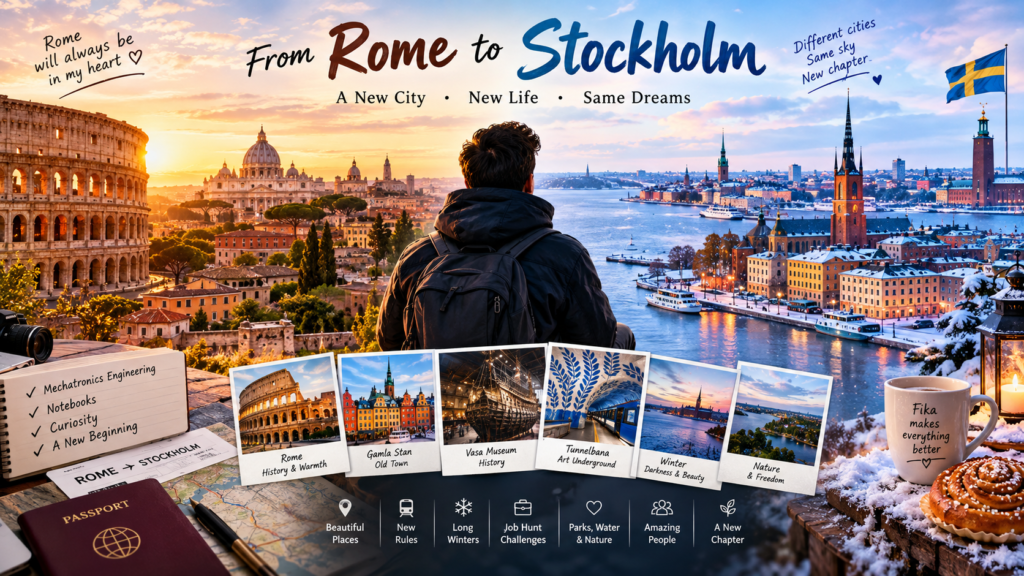
Moving to Stockholm from Rome felt like stepping from one beautiful world into another.
Rome is full of warmth, history and life — a city I will always love. In 2025, I packed my Mechatronics Engineering degree, my notebooks and a lot of curiosity, and moved north.
This is the honest story of my first year in Stockholm — the beautiful places, the strange new rules, the long dark winters and the hard parts nobody posts on Instagram.
A New City, New Faces, a New Silence
The first thing I noticed in Stockholm was the silence. Not an empty silence — a calm one.
On my first metro ride, nobody was talking on the phone. People sat with headphones, reading or looking out of the window. In Rome, a bus ride is a conversation; here, it felt almost like a library on wheels.
At first, people seemed a little reserved to me. They don’t smile at strangers, and they rarely start small talk. Over time I understood it differently: Swedes respect your space. Once you get to know someone, the warmth is real — it just takes longer to arrive.
I also felt very new. New language, new streets, new rules for almost everything. Some days that felt exciting. Other days, honestly, it felt lonely.
Beautiful and Historic Places That Made Me Fall in Love
Coming from Rome, I thought nothing could impress me with history. Stockholm proved me wrong — in a completely different style. Rome is marble and ruins; Stockholm is water, islands and colourful old houses. The city is built on 14 islands, and water is everywhere you look.
Gamla Stan (the Old Town) was my first love. Narrow cobblestone streets, tall yellow and red houses around Stortorget square, and small cafés hidden in medieval cellars. Walking there in the evening feels like stepping into a fairy tale.
The Royal Palace (Kungliga slottet) sits right at the edge of Gamla Stan. It is one of the largest palaces in Europe, and the changing of the guard is worth watching at least once.
Stockholm City Hall (Stadshuset) stands by the water with its tall brick tower. This is where the Nobel Prize banquet is held every December. Climb the tower in summer — the view over the islands is unforgettable.
Museums I recommend:
- Vasa Museum — a real 17th-century warship that sank on its first voyage in 1628 and was lifted from the sea more than 300 years later. Standing next to it gave me goosebumps.These places made moving to stockholm feel exciting from the very first week.
- Skansen — the world’s oldest open-air museum, with old Swedish houses, traditions and Nordic animals.
- Nobel Prize Museum — in Gamla Stan, full of stories about ideas that changed the world.
- ABBA The Museum — fun, loud and very Swedish.
- Fotografiska — a photography museum by the water, with one of the best café views in the city.
As an engineer, the Vasa Museum touched me the most. A ship built to show power, which sank because of a design mistake — it is a beautiful lesson about humility.
The Tunnelbana: An Art Gallery Underground
In Stockholm, the metro — called the tunnelbana — is often described as the world’s longest art gallery.
Honestly, the transport system was the first thing that truly impressed me when I arrived. I remember standing on the platform during my first days, watching the trains glide in exactly on time, clean and quiet, and thinking: this is how a city should work. As an engineer, I could not stop admiring how well everything was connected.
Most of its stations are decorated with paintings, sculptures and installations. Some of my favourites:
- T-Centralen — the main station, with calm blue vines and leaves painted on the rock walls.
- Kungsträdgården — feels like an underground garden full of old statues and colours.
- Solna Centrum — a dramatic red sky over a green forest.
- Stadion — a bright rainbow painted across the blue cave ceiling.
The system itself is simple. One ticket works on the metro, buses, commuter trains, trams and even some ferries. I just tap my bank card or use the SL app, and a single ticket covers transfers for 75 minutes.
Trains come every few minutes, and they leave exactly on time. That punctuality felt almost unreal to me.For me, the tunnelbana was the easiest part of moving to Stockholm.
Parks, Water and Nature Inside the City
Stockholm is a capital city, but nature never feels far away. Around a third of the city is green space, and another big part is water.
- Djurgården — a royal park island with forests, walking paths and museums. My favourite place for a long Sunday walk.
- Kungsträdgården — in the city centre. In April, its cherry trees bloom pink, and the whole city comes to take photos.
- Hagaparken — a huge, calm park with lakes and old royal pavilions.
- Tantolunden — on Södermalm, full of picnics and sunbathers in summer.
- Monteliusvägen — a small path on Södermalm with one of the best views of Gamla Stan and City Hall, especially at sunset.
Swedes also have something called allemansrätten — the right of public access. It means everyone can walk, swim and enjoy nature freely, as long as you respect it. For me, this felt like a beautiful kind of freedom.If you love nature, moving to Stockholm will feel like a gift.
The Weather: Light, Darkness and a Lot of Layers
The weather was the biggest shock of all.
In summer, Stockholm is magical. Around midsummer, the sun stays up for about 18 hours, and the sky never gets fully dark. People sit by the water until midnight, and the whole city seems happy.
In winter, it is the opposite. In December, there are only about six hours of daylight, and the sun stays low even at noon. Temperatures often hover around zero or below, and some days it is grey from morning to evening.
What surprised me most was the snow. Snow was something new for me, and I expected the city to slow down. Instead, life simply continues. During heavy snowfall, people still go to work, children still go to school, and the tunnelbana and buses keep running. Snow ploughs clear the roads early in the morning, and nobody stays home just because of the weather. Watching people walk calmly through the snow to the metro, coffee in hand, I understood that here, winter is not an excuse — it is simply part of life.
Coming from Rome’s mild winters, I had to learn three things fast:
- Buy a proper winter jacket and good shoes — Swedes say there is no bad weather, only bad clothes.
- Go outside during daylight hours, even for a short walk.
- Enjoy the cosy side of winter: candles, warm cafés and fika with friends.
The darkness is real, but so is the beauty of the first snow over Gamla Stan.If you are moving to Stockholm, plan your first winter carefully — it makes everything easier.
Traffic: Calm Streets and a Lot of Bicycles
Walking around Stockholm, I quickly noticed how calm the streets are.
Cars stop for pedestrians at zebra crossings, every time. Almost nobody honks. Most people wait for the green light, even when the road is empty.
Bicycles are everywhere, with their own lanes and traffic lights. Many people cycle to work all year, even in snow. Buses and the metro are so reliable that many locals don’t own a car at all.
There is still traffic at rush hour, and some roads into the city have a congestion charge. Still, the city feels quiet, organised and easy to move around
Work and Job Hunting: The Hardest Part
If I am honest, finding work in Stockholm has been the hardest part of moving here.For anyone moving to Stockholm for work, this is the part to prepare for most.
Here is what made it difficult for me:
- Language. Many jobs ask for Swedish, even when the office speaks English every day. Without Swedish, the number of open doors becomes much smaller.
- Paperwork first. To work, rent, open a bank account or even see a doctor easily, you usually need a personnummer (personal identity number). Getting it takes time and patience.
- Networks matter. Many jobs are filled through contacts and recommendations, not only job ads. As a newcomer, I didn’t know anyone at first.
- Slow hiring. Interviews can take weeks, and in July much of Sweden goes on summer holiday, so hiring almost stops.
- Experience abroad. A degree from Rome is respected, but some employers still prefer Swedish work experience.
What helped me:
- Learning Swedish step by step, even a little every day.
- Keeping my LinkedIn profile updated and connecting with people in my field.
- Building my own work online — my blog, freelance writing and SEO — instead of only waiting for replies.
Once you are inside, Swedish work culture is wonderful: flat hierarchy, respect for free time, and the famous fika coffee break that brings everyone together.
Swedish People: Quiet, Fair and Full of Rules
Swedish people taught me that respect can be quiet.
- Punctuality. If a meeting starts at 10:00, people arrive at 9:58. Being late is seen as disrespectful.
- Queues. In shops, pharmacies and offices, you take a number from a small machine and wait for your turn. Nobody pushes ahead.
- Personal space. People keep distance on buses and at bus stops. Loud phone calls in public feel almost rude.
- Lagom. A Swedish word meaning “just the right amount” — not too much, not too little. It shows up everywhere: in food, in work, even in how people talk about success.
- Equality. Bosses and employees speak as equals, and showing off is not appreciated.
- Trust and rules. People follow rules even when no one is watching — from recycling bottles for the deposit to keeping parks clean.
As a newcomer, this took a little getting used to. Now I admire it. The system works because almost everyone does their small part.Understanding these small rules is one of the best things you can do when moving to Stockholm.
Moving to Stockholm: Rome Gave Me Roots, Stockholm Gave Me Space
Moving to Stockholm was not easy. The dark winters, the language and the job hunt tested my patience more than any engineering exam.
But this city also gave me calm streets, endless water, beautiful parks and the space to start a new chapter as a writer. Rome will always be in my heart. Stockholm is where I am learning who I want to become.
If you are thinking about moving to Stockholm, my advice is simple: bring a warm jacket, learn a few Swedish words, and give the city time. It opens up slowly — but when it does, it stays with you.
Have you ever moved to a new country? What surprised you the most? Tell me in the comments.
Read the first part of my story: From Mechatronics Engineering to Writing.